The best coaches know that sport teaches more than sport. The discipline of showing up to training when you don’t feel like it. The habit of watching the whole pitch rather than just the ball. The ability to stay composed when the game is going against you and execution feels harder than it should. These are qualities that transfer to every other part of life, and they are also, it turns out, the same qualities that the animal world has been refining for millions of years.
The Okavango Delta in northern Botswana is the largest inland delta on earth: a vast seasonal flood plain where the Okavango River spills from the Angolan highlands into the Kalahari sand and spreads across 15,000 square kilometres of channels, islands, reed beds, and open flood plain before evaporating without ever reaching the sea. It supports one of the most concentrated and diverse wildlife populations remaining in Africa, and spending time in it teaches you things about movement, coordination, strategy, and mental focus that no classroom or training session quite replicates.
Here are eight lessons the Delta delivers to anyone who pays attention.
1. The Wild Dog Pack Is the Best Teamwork Model in Nature
African wild dogs are the most successful large predators on the continent by hunt success rate, succeeding in roughly 80 percent of their pursuits compared to around 30 percent for lions. The difference is not speed or power. It is coordination. Wild dog packs operate with a level of role differentiation and communication that wildlife researchers have spent decades trying to fully decode: some individuals drive the prey, others flank, others pace themselves to take over when the leaders tire. The hunt is a collective execution of a strategy, not a competition between individuals.
For young footballers, this is a lesson worth absorbing. The player who chases the ball individually and loses it has failed the team. The player who reads the movement pattern and positions for the second ball, the third pass, the channel that opens after the first pressure is applied: that player is operating the way a wild dog operates. The Okavango is one of the few places in Africa where wild dog sightings are reliable, and watching a hunt unfold across the flood plain changes how you think about what coordinated movement actually looks like at full speed.
2. Reading the Environment Is a Skill That Transfers Directly to the Pitch
A good safari guide in the Okavango reads the landscape the way a good midfielder reads a football match. The broken grass stem that indicates an elephant passed through in the last hour. The oxpecker bird sitting still on a bush rather than feeding. The direction a herd of impala is looking, ears forward, bodies half-turned toward a line of reeds. These are the small signals in a dynamic environment that tell you where the significant event is about to happen and in which direction everything is about to move.
This is exactly the kind of environmental reading that distinguishes a composed footballer from a reactive one. The player who sees the defender shift their weight before the ball arrives. The striker who reads the goalkeeper’s stance and knows which side is open before the shot. Spending time in the Delta, where reading subtle environmental signals is the difference between seeing the leopard and missing it, trains exactly this quality of distributed, anticipatory attention. The skill is transferable. The environment just makes it visceral in a way that a training drill can’t.
3. Elephant Herds Demonstrate Leadership and Collective Decision-Making
Elephant herds are matriarchal societies led by the oldest female, whose accumulated memory of water sources, safe corridors, and seasonal patterns determines the survival of the group. She leads not through dominance or aggression but through knowledge and the trust that knowledge generates over decades of demonstrated competence. When the matriarch moves, the herd moves. When she stops, they stop. When she signals alarm, the response is immediate and coordinated.
For young athletes developing their understanding of what leadership in a team actually means, watching an elephant matriarch manage a herd of thirty animals across a changing floodplain is an education that abstracts directly to the pitch. The captain who has earned their role through demonstrated knowledge and consistency commands a different quality of response from teammates than the one who commands through volume or authority alone. The Delta makes this distinction visible and physical in a way that any young person with sporting ambitions can read without any mediation.
4. Predators Teach Patience, Preparation, and the Decisive Moment
A lion can sleep for up to twenty hours a day. Those twenty hours are not laziness. They are energy conservation in service of the four hours of activity that matter. A leopard in the Okavango may spend three hours in a tree above a waterhole, completely still, watching the patterns of approach and departure of every animal that comes to drink, before making a movement. The patience and the preparation are inseparable from the decisive action that follows.
This is one of the most direct lessons the Delta offers to anyone with a sporting background. The training session that seems repetitive is the lion sleeping. The pattern recognition that a player develops over hundreds of hours of drills is the leopard watching the waterhole. When the moment comes in the match, the player who has done the preparation acts without hesitation because the decision was made long before the situation arose. As we discuss in our overview of the way of the champion, the qualities that produce peak performance are built in the hours that nobody sees, not the moments that everybody does.
5. The Seasonal Flood Teaches Adaptation and Response to Changing Conditions
The Okavango Delta floods annually, but not predictably. The floodwaters from Angola arrive in the delta between March and August, months after the local rains have ended, moving south through the system at a pace of about one kilometre per day. The timing varies. The extent varies. The channels that carried water last year may be dry this year, and new channels open as papyrus dies and water finds new paths through the sand.
Every animal in the Delta adapts its behaviour to the current state of the flood rather than the expected state. The herds that were on the eastern islands last month have moved to the western flood plain because the water is there now. The predators have followed. The birds have redistributed across the new shallow areas. The entire ecosystem is in continuous adjustment to real conditions rather than anticipated ones. For a footballer, the lesson is the same one that the best coaches teach in every session: you play the game that is in front of you, not the game you prepared for. The plan is the starting point, not the script.
6. Guided Tours Reveal the Depth That Surface Observation Misses
The Okavango Delta is large enough and complex enough that independent observation from a single fixed point produces a fraction of what a guided experience delivers. The channels, islands, and flood plains that look uniform from a distance have specific ecologies, specific animal populations, and specific seasonal dynamics that a guide who knows the territory can navigate toward in ways that are not available to a visitor finding their own way.
Operators like Okavango Delta Botswana Tours run mokoro excursions, game drives, and walking safaris through the Delta’s key ecosystems with guides whose knowledge of the territory, the animal behaviour patterns, and the seasonal conditions turns an afternoon in the bush into a structured education in how the ecosystem functions. For families or groups visiting with young athletes who want more from the experience than photographs, this kind of guided depth is the difference between sightseeing and learning.
7. Bird Behaviour in the Delta Is a Masterclass in Positioning and Spatial Awareness
The Okavango Delta supports over 400 bird species, many of them visible from a mokoro canoe moving through the reed channels in the early morning. Watching them is an exercise in reading positioning and spatial awareness at speed. The African fish eagle that holds a branch above a channel, watching the water below for movement at the surface. The saddle-billed stork that stands still in shallow water, one foot raised, waiting for a fish to pass within range. The carmine bee-eater colony that launches from its nest bank in precise coordinated bursts to take insects on the wing, each individual finding the gap in the air that the others have left.
Every one of these behaviours is a positioning problem solved in real time. The eagle has chosen the perch that gives the best sightline over the most productive stretch of channel. The stork has identified the depth and clarity that maximises its strike success rate. The bee-eater has found the airspace that isn’t already occupied by a competitor. These are the same spatial calculations that the features of the game of football demand constantly: where to be, when to move, how to find the space that the opposition has left available. The Delta makes that problem visible in three dimensions and at every scale from the individual bird to the colony.
8. Botswana’s Conservation Model Is One of the World’s Most Successful
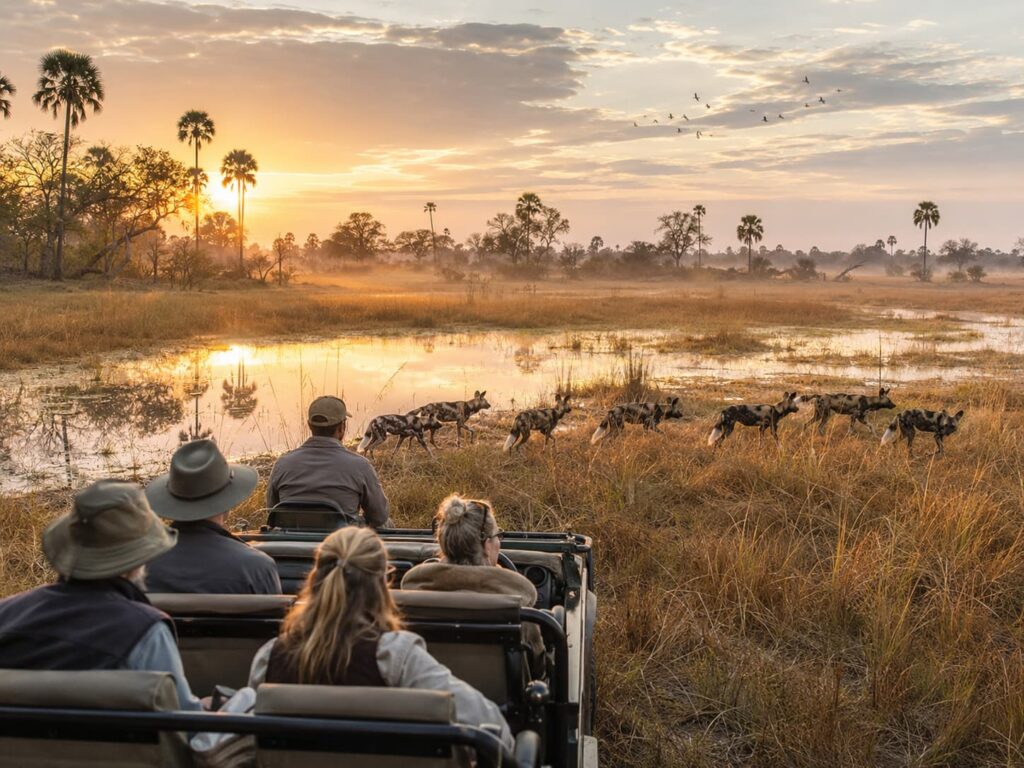
Botswana made a decision in the 1990s to pursue a high-value, low-volume tourism model for its wildlife areas: fewer visitors, higher prices, and maximum protection for the ecosystems that make the destination possible. The Delta and the surrounding Chobe and Moremi reserves are among the best-managed wildlife areas in Africa as a result, with elephant populations that have grown significantly, wild dog populations that are stable, and habitat that is protected from the agricultural expansion that has degraded comparable ecosystems elsewhere on the continent.
For young people developing a sporting ethic, the Botswana conservation model is worth understanding as a long-term strategy story. The decision to invest in protection rather than short-term extraction, to limit access rather than maximise it, and to measure success in decades rather than seasons: these are the same calculations that a serious athlete makes about their own development. The player who protects their body, manages their training load, and builds technical foundations over years before pushing for peak performance is running the same strategic model as Botswana’s wildlife management system. The outcomes, in both cases, speak for themselves.
A Final Thought
The qualities that make a great footballer, coordination, focus, patience, adaptability, spatial intelligence, and the willingness to put in invisible work in service of a decisive moment, are not invented on the training pitch. They are human capacities that the natural world has been developing and refining across millions of years of evolution, and the Okavango Delta is one of the best places on earth to watch them in action at full scale.
A week in the Delta does not make a better footballer directly. But it builds the kind of observational intelligence, the habit of reading dynamic environments and anticipating what comes next, that coaches spend years trying to develop in young players through drills and repetition.
The elephant matriarch has been doing it longer. She has a few things to teach.